Adding the agentic layer: a web-lookup agent for live regulatory context
How I added a web-lookup agent to the Responsible Digital Health Checker to surface live EU regulatory discussions — the one thing static RAG files can't capture.
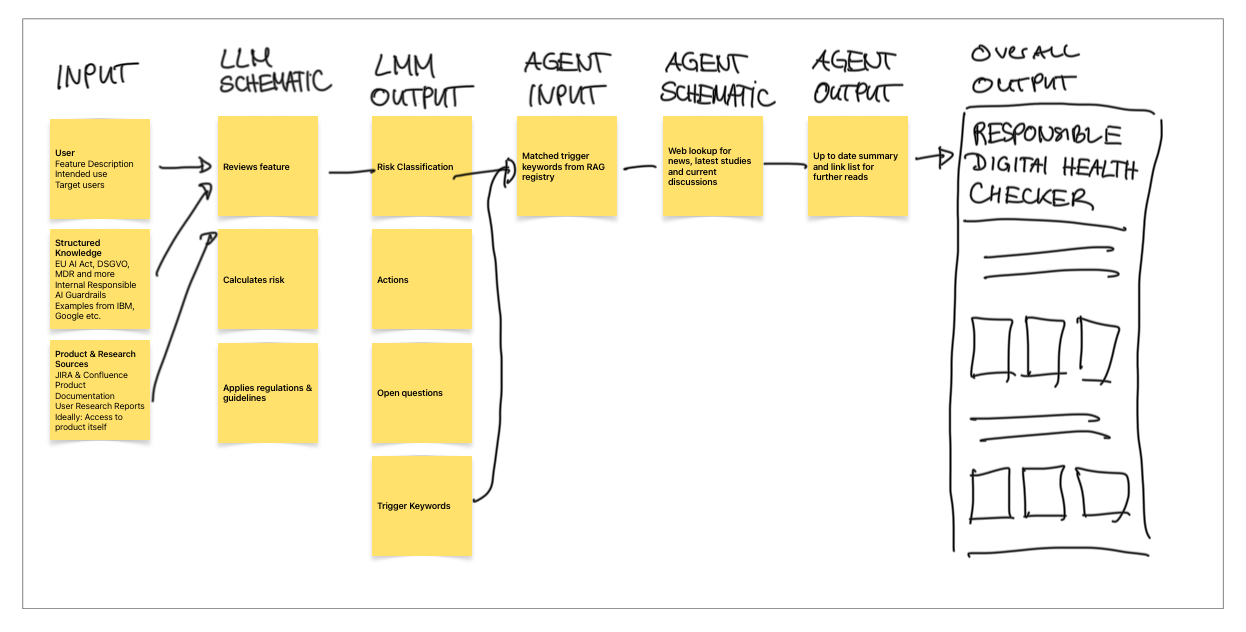
The last piece of the training was adding an agent. Before coding, I went back to the storyboard, value proposition, and digital twin to decide what it should do. I had plenty of ideas, but the recommendation was to start simple with a web-lookup agent.
That fit my problem. The Responsible Digital Health Checker leans almost entirely on static RAG files built from legal text: accurate, but frozen. EU health regulation is in active flux, so I used the agent to add the one thing RAG can’t — currency. That is not helping to reduce the highest risk identified in the value matrix, but still, a helpful addition for users.
How it works
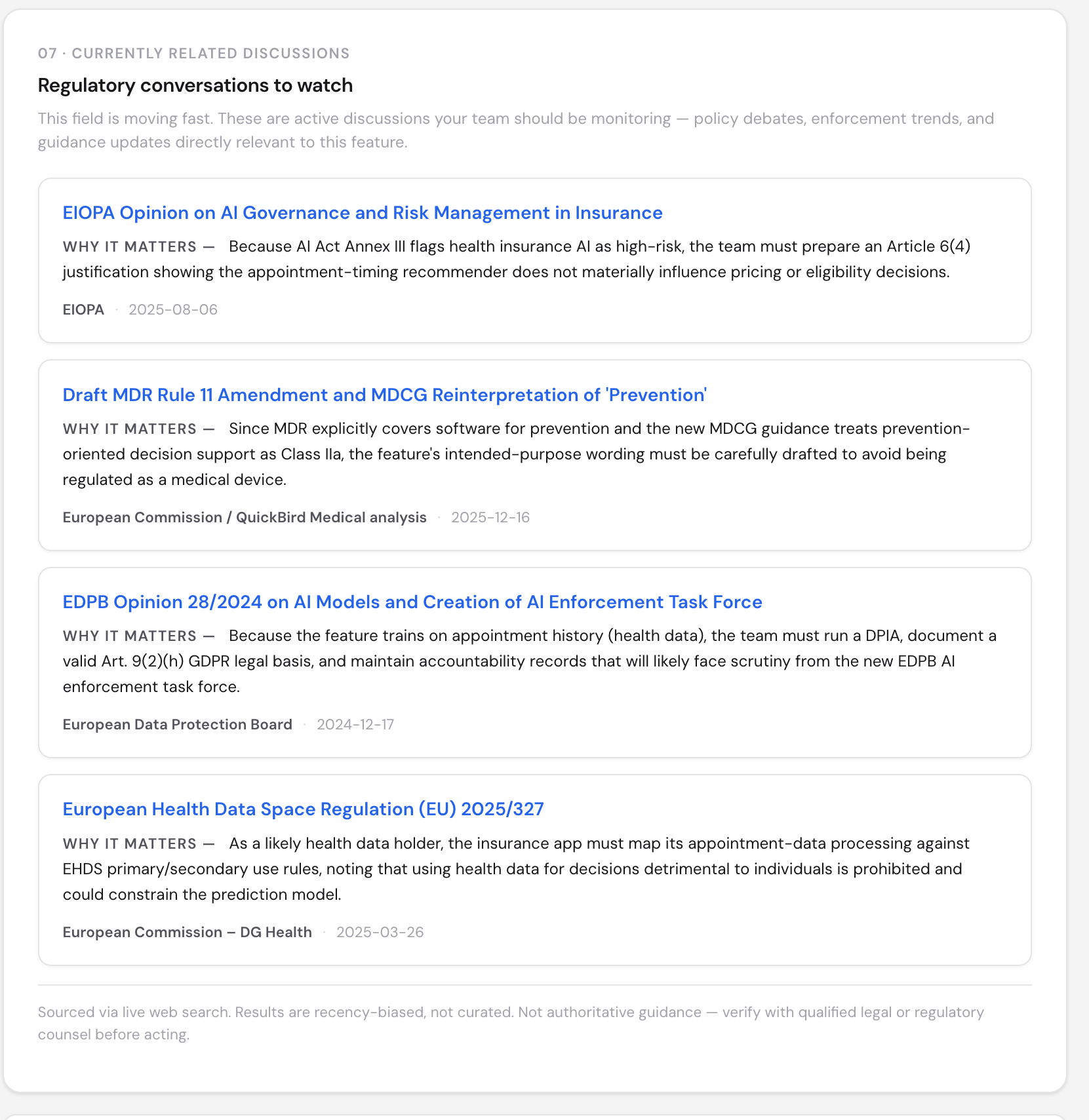
After the main classification runs, the LLM hands a few keywords to the agent. The agent searches the web, summarises why each result matters for the feature, and the findings render in a section at the end: Regulatory conversations to watch. The RAG layer holds the settled law; the agent surfaces the living discussion around it.
Debugging and success
The agent’s results often didn’t show up. The core mistake was conceptual: I treated the web-search tool as something my code had to feed and loop through manually, but it’s server-side — the model runs the search itself and returns results in the same response. My code was talking over the API, which broke parsing and made the section silently vanish.
The fix was to split the work into two clean calls: one that only searches and describes what it found, and one that only reshapes that into structured data. Each call has a single job. I also added a fallback so the section always appears — if nothing is found, it says so, because an absence of discussion is itself a signal.
What I learned
- An agent can reshape the value matrix — mine barely did. A simple web lookup adds modest value, which is fine for a training project.
- The storyboard could shift, but didn’t much. It would be a different story with a product-knowledge agent wired into the product, Confluence, and JIRA.
- The digital twin changed. There’s now a handover between LLM and agent. More agents and loops would grow that schematic fast.
- I’ve only touched the surface. I built this via vibe coding, not a workflow tool — I could follow along, but would struggle to set it up unaided.
- It would have changed my last project. I’d now understand this layer well enough to discuss it at the product level and with developers, where before it was a black box.